Syntaxe · a systems lab

Syntaxe is a technology company: a systems lab building inspectable computational engines for security, law, science and critical infrastructure, plus an engineering practice for organisations solving difficult technical problems.

Reach the lab at hello@syntaxeltd.com · Syntaxe Ltd.

move · it knows you're here
Syntaxe Ltd  ·  Building advanced computational systems for complex domains
Syntaxe Ltd · the lab

A systems lab.

The Lab is Syntaxe’s research and engineering core. We turn difficult, fragmented domains into computational systems that can be inspected, tested, and used. Our work spans security, law, science, biology, and critical infrastructure, built from evidence, formal models, and domain constraints rather than fluent approximation.

scroll · the thesis, the systems, the lines we hold ↓
the thesis

Complex domains need more than answers.

An answer is useful only when its sources, assumptions, authority, and limits remain visible. We build systems that make those structures explicit: the state of the problem, the rules that govern it, the evidence supporting it, and the path from input to result.

Where formal proof is possible, the system supplies it. Where proof is not possible, it exposes uncertainty, preserves the evidence, and returns the decision to a human.

Engineers reviewing a verification run against a wall display in the Syntaxe lab.
the lab · a verification run, reviewed
the depth

Different disciplines. One way of building.

Every Syntaxe engine is built around the same underlying primitives.

State
Constraint
Provenance
Verification
Observability
Human authority

Each system belongs to its own domain. The following systems are ready for public examination.

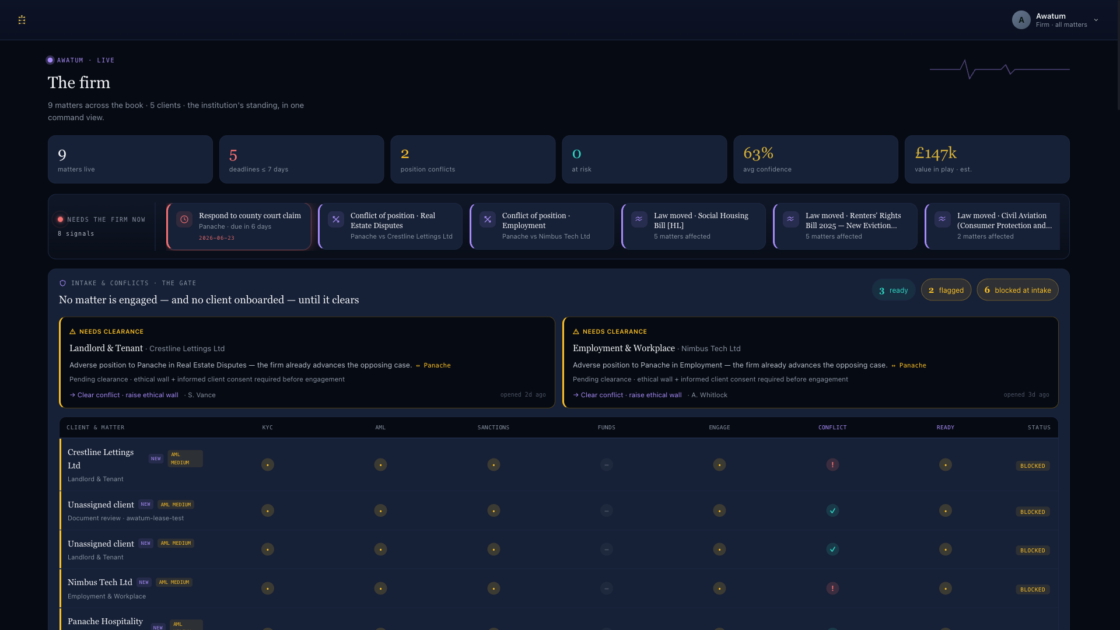
KERNprovable containment for agent systemsKERN compiles an agent mesh’s declared tools, data labels, and authority boundaries into a runtime monitor and a re-checkable certificate. It can reject forged certificates, identify unauthorised routes, and produce a concrete counterexample when a permitted path violates policy.working demonstrator · portable proof certificate · independently re-checkableenter →AWATUMcomputable legal stateAWATUM models facts, rights, obligations, evidence, procedure, deadlines, and authority as one evolving legal state. Its outputs remain linked to primary sources, visible reasoning, and the human approvals required before legal action is taken.live operating system · graph-native engines · five perspectives, one systementer →VERITYscientific claims, examined against their evidenceVERITY evaluates claims across statistical, textual, image, methodological, data, reference, and provenance signals. It identifies what requires expert examination, shows the supporting evidence, and preserves the distinction between a warning signal and a verdict.working engine · seven verification axes · traceable methodsenter →ANNEALsecurity that attacks its own assumptionsANNEAL continuously models reachable attack paths, tests them, identifies material weaknesses, and re-runs the model after remediation. It is designed to prioritise the small number of actions that materially change exposure rather than generate another undifferentiated alert stream.continuous adversarial testing · reachable-path analysis · evidence-ranked alertsenter →CODECbiology as a dynamic computational systemCODEC is a research platform exploring genomic regulation, cell-state stability, differentiation, and phenotype as dynamics over a structured state space. It treats the genome not merely as a sequence to catalogue, but as a regulatory system whose behaviour must be modelled and experimentally tested.computational genomics · dynamical-systems framework · research-stageenter →
syntaxe engineering

Research becomes capability.

Syntaxe engages commercially, today. We apply the same systems discipline used inside the Lab, explicit state, tested behaviour, evidence over confidence, to technically difficult work for organisations that need more than an off-the-shelf product.

software & platforms · cloud & infrastructure · cybersecurity & network security · digital products & interfaces · computational systems · research & technical validation

Engagements begin with a scoping conversation, not a sales process.

An engineer reviewing system behaviour late at night.
the lab · behaviour, examined
why now

More systems are becoming operational before they are becoming understandable.

Operational systems are becoming more interconnected and consequential. Autonomous systems are gaining authority. Scientific evidence is growing faster than it can be examined. Specialist domains remain fragmented across documents, tools, datasets, and institutional memory.

Systems like these are being given authority faster than anyone can inspect them. That is the gap Syntaxe builds into.

Syntaxe’s advantage is not access to a model. It is the domain architecture, evidence structures, verification discipline, and engineering accumulated inside each system.

what we hold to

The lines we do not cross.

Proof where proof is possible. Evidence everywhere else.
We do not relabel confidence as certainty. Every material claim must trace to evidence, a formal result, or an explicit statement of what remains unknown.
Human authority remains visible.
Each system declares where its authority ends. It may analyse, model, warn, or recommend. It does not quietly replace the human judgement that must remain human.
Limits are part of the output.
A system that cannot identify uncertainty is not ready for consequential use. Unknown is a valid result.
Built to survive handover.
We build systems to remain inspectable, maintainable, and accountable throughout their operational life.
We build slowly enough to understand what we are shipping, and rigorously enough that another person can examine how it works.

We put a system in public when it can be tested, not when it can be announced. For technical work, research collaboration, or strategic partnership, there is a direct route into Syntaxe.

syntaxe ltd · a systems lab
Syntaxe Ltd · engineering services

Research becomes capability.

Syntaxe engages commercially, today. We apply the same systems discipline used inside the Lab, explicit state, tested behaviour, evidence over confidence, to technically difficult work for organisations that need more than an off-the-shelf product.

scroll · what we do, how an engagement runs, how it starts ↓
why us

Our proof is not a case study. It is a product.

Most engineering firms ask you to trust a testimonial. We build our own systems, in domains where being wrong is expensive, and put them where they can be examined. The discipline we would bring to your problem is already visible in work we own.

That is the whole argument. The standard we would hold your project to is the one our own systems are already held to, and you can go and check it before you speak to us.

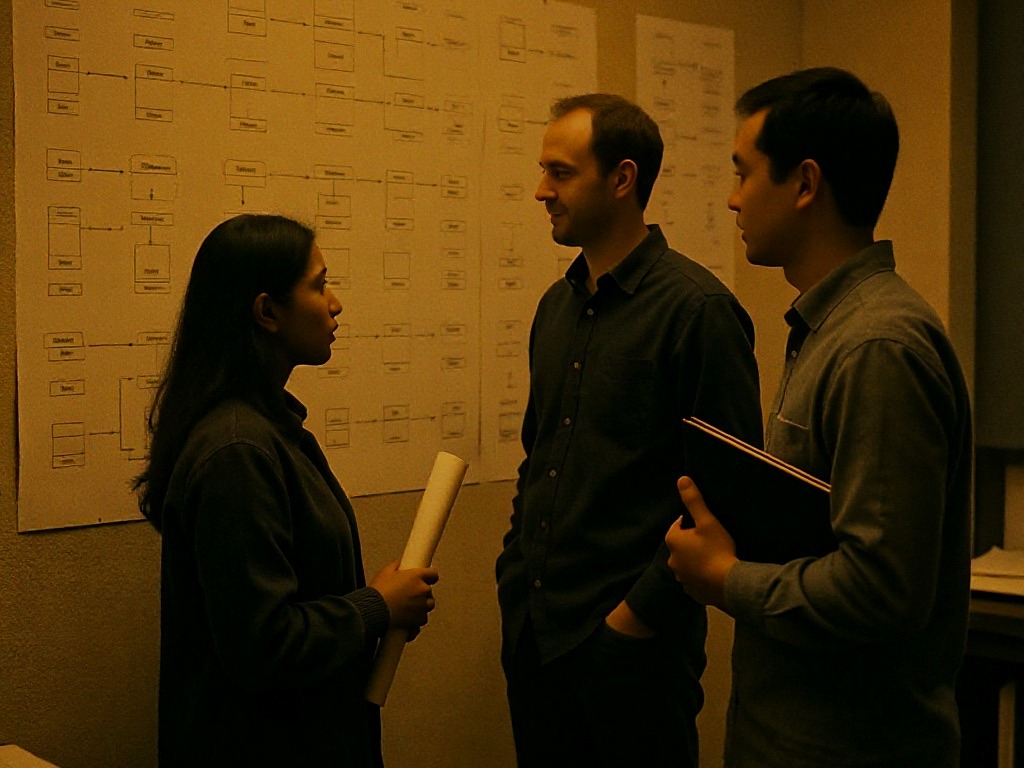
Three Syntaxe engineers working through a system architecture on a printed wall.
syntaxe engineering · an architecture, worked through
KERNprovable containment for agent systemsKERN compiles an agent mesh’s declared tools, data labels, and authority boundaries into a runtime monitor and a re-checkable certificate. It can reject forged certificates, identify unauthorised routes, and produce a concrete counterexample when a permitted path violates policy.working demonstrator · portable proof certificate · independently re-checkableenter →AWATUMcomputable legal stateAWATUM models facts, rights, obligations, evidence, procedure, deadlines, and authority as one evolving legal state. Its outputs remain linked to primary sources, visible reasoning, and the human approvals required before legal action is taken.live operating system · graph-native engines · five perspectives, one systementer →VERITYscientific claims, examined against their evidenceVERITY evaluates claims across statistical, textual, image, methodological, data, reference, and provenance signals. It identifies what requires expert examination, shows the supporting evidence, and preserves the distinction between a warning signal and a verdict.working engine · seven verification axes · traceable methodsenter →ANNEALsecurity that attacks its own assumptionsANNEAL continuously models reachable attack paths, tests them, identifies material weaknesses, and re-runs the model after remediation. It is designed to prioritise the small number of actions that materially change exposure rather than generate another undifferentiated alert stream.continuous adversarial testing · reachable-path analysis · evidence-ranked alertsenter →CODECbiology as a dynamic computational systemCODEC is a research platform exploring genomic regulation, cell-state stability, differentiation, and phenotype as dynamics over a structured state space. It treats the genome not merely as a sequence to catalogue, but as a regulatory system whose behaviour must be modelled and experimentally tested.computational genomics · dynamical-systems framework · research-stageenter →
what we do

Six lines of work. One standard.

We take on technically difficult work for organisations that need more than an off-the-shelf product. Whichever line the work sits in, it is delivered the same way: explicit state, tested behaviour, and documentation another engineer can pick up without us in the room.

Software & platforms

We design and build software from a blank page or inside an existing codebase: enterprise platforms, internal tools, APIs, and the integrations that connect them. Delivery follows the same discipline as the Lab’s own engines: explicit state, tested behaviour, and documentation another engineer can pick up without us in the room.

custom builds · platform extension · API & integration design
Cloud & infrastructure

We design and operate the infrastructure underneath a product: architecture, deployment pipelines, observability, and the resilience work that keeps a system up when it matters. Migrations are planned around the business’s actual risk tolerance, not a vendor’s roadmap.

architecture & migration · deployment automation · observability & resilience
Cybersecurity & network security

We assess and harden the systems an organisation already runs: architecture review, identity and access design, network segmentation, and the monitoring that turns an incident into a contained event instead of a headline. Findings are prioritised by what is actually reachable, not by a generic severity score.

architecture review · identity & access · monitoring & hardening
Digital products & interfaces

We take a product from a rough idea to something a real user can hold: interface design, a design system that survives more than one release, and the engineering to ship it. The same craft standard visible on this site is the standard we bring to a client’s.

concept to launch · design systems · production engineering
Computational systems

For problems that do not fit off-the-shelf software, we build the engine itself: simulations, decision-support systems, and analytical infrastructure modelled on the domain’s actual constraints, not a generic template. This is the same discipline behind the Lab’s own engines, scoped to a client’s exact problem.

bespoke engines · simulation & modelling · decision-support systems
Research & technical validation

We act as an independent technical assessor: reviewing a system, a claim, or an acquisition target on its merits, and stating plainly what holds up and what does not. This is the same evidentiary standard VERITY applies to a scientific claim, applied to a commercial decision.

technical due diligence · independent assessment · research collaboration
how an engagement runs

Three shapes. You choose the one that fits.

Work is bounded before it begins. You should know what you are buying, how long it runs, and what you hold at the end of it.

Technical assessment

A fixed-scope review of a system, a claim, or an acquisition target. We examine it on its merits and write down what holds up, what does not, and what we could not determine. You hold a document you can act on or put in front of a board.

two to three weeks · fixed scope · written findings
Systems build

Design and delivery of the system itself, run in phases with a working result at the end of each one. Every phase is a real boundary: you can stop, change direction, or continue on what you have seen rather than on what we promised.

three months upward · phased · a working result per phase
Retained advisory

Ongoing technical counsel for a team that owns its own delivery: architecture decisions, review of work in flight, and a second pair of eyes on the choices that are expensive to reverse. Monthly, and cancellable.

monthly · ongoing · cancellable
A scoping conversation across a table, a printed document between the two people.
syntaxe engineering · where every engagement starts
how it starts

A conversation, then a written scope.

One
A scoping conversation. You describe the problem. We tell you honestly whether it is ours to solve, and say so if it is not.
Two
A written scope: what we will do, how long it runs, what you receive, and what falls outside it. Nothing begins on a handshake and an assumption.
Three
The first phase begins. You see working output at its boundary, not at the end of everything.

You will have the shape and the cost of the work in writing before you commit to any of it.

what we hold to

The terms are the same as the Lab’s.

We tell you when it is not ours.
If the problem is better solved by an existing product, a different discipline, or nobody at all, that is what the scoping conversation will say. We would rather lose the work than take it badly.
Built to survive handover.
What we build stays inspectable and maintainable after we leave. You should never be held hostage by the only people who understand your own system.
Findings are not softened.
An assessment reports what we found, including the parts that are inconvenient and the parts we could not determine. Unknown is a valid result and it will be written as one.
Your work is yours.
We do not publish a client’s system, name, or findings without their word. The proof on this site is our own work, which is exactly why we can show it.
The fastest way to find out whether we are right for the problem is to describe the problem.

Engagements begin with a scoping conversation, not a sales process.

syntaxe ltd · engineering services
Syntaxe Ltd · careers

We hire rarely,
and deeply.

The lab grows by a person at a time. We look for minds that want to build things that outlast them: people who prefer proof to opinion, who would rather be right and slow than fast and plausible, who are drawn to the hardest problems because they remain unsolved.

If that is you, do not send only a résumé. Send us the thing you would build, why it matters, and why no one has built it properly yet.

Tell us what you'd build →
the work

Problems that stay unsolved because they are genuinely hard.

Syntaxe builds computational systems for domains where being wrong is expensive: security, law, science and critical infrastructure. The work is modelling a domain properly, then proving the system behaves as claimed, then stating plainly where it stops.

It is slower than most engineering jobs and considerably less forgiving. Nothing ships on the strength of a demo. If you cannot show how a thing was verified, it is not finished, and that applies to everyone here including the founder.

An engineer annotating a printed specification at a desk late at night.
the lab · a specification, read properly
how we work

The standard is the same for everyone.

Proof beats opinion.
Disagreements are settled by going and checking, not by seniority. Being wrong quickly is fine. Being confidently unverified is not.
You own the whole thing.
Not a ticket queue. You take a problem from the domain modelling through to the verification and the handover, and your name is on how it behaves in production.
Depth over pace.
We would rather ship one thing that survives examination than four that survive a demo. If that reads as slow to you, this is not the right place.
Written down, or it did not happen.
Everything is built to survive the person who built it leaving. That discipline is not bureaucracy here, it is the product.
who this suits

And who it does not.

Suits
People who go and read the specification. Who are drawn to a domain rather than a stack. Who would rather be right and slow than fast and plausible, and who want their work examined.
Does not
People who need a large team around them, a defined ladder, or a settled roadmap. A small company is an unusual amount of ownership and an unusual amount of ambiguity, in the same job.
Honest
Syntaxe hires rarely and grows a person at a time. That is deliberate, but it means there is rarely a queue of open roles, and an approach may sit until the right work exists for it.
Also honest
We will tell you if the answer is no, and why. Silence is not a decision and we do not use it as one.
how to approach us

Do not send only a résumé. Send the thing you would build.

A CV tells us where you have been. We also want to understand how you think when the problem is difficult, the path is unclear and the work is yours to own.

Send the thing you would build, why it matters and why no one has built it properly yet. Use whatever form makes the argument best: a page of prose, a proof, a repository, a diagram or a working prototype.

One
Send the idea. We read every serious approach and respond either way.
Two
We talk about the problem itself, not rehearsed competencies. Expect to be pressed on your assumptions, tradeoffs, failure modes and what you do not yet know.
Three
A small, paid piece of real work. Both sides learn how the other thinks, builds, communicates and handles uncertainty before making a longer commitment.

There is no listed opening at the moment. That does not close the door. The right problem, argued properly, is enough to begin a conversation.

We look for minds that want to build things that outlast them.

If that is you, tell us what you would build, why it matters, and why no one has built it properly yet.

syntaxe ltd · we hire rarely, and deeply
Syntaxe Ltd · contact

Reach the lab.

Five routes in, going to different places. Pick the one that matches what you need and say what the problem actually is: that is the whole first step, and it is the difference between a reply this week and a reply eventually.

pick the one that fits

Five ways in. They go to different places.

These are not aliases for the same inbox. Choosing the right one, and saying what you actually need, is the difference between a reply this week and a reply eventually.

Technical work hello@syntaxeltd.com

You have a technically difficult problem and want to know whether it is ours to solve. Software, infrastructure, security, computational systems, or an independent assessment of something you already own.

Engineering Services →
the problem in your own words · what you have already tried · when it needs to be true by

You invest in deep technology and want the materials, or a conversation with the person who built the systems rather than someone briefed on them.

For investors →
your fund or vehicle · stage and cheque size you write · what you would need to see
Research & press press@syntaxeltd.com

You want to collaborate on research, examine a claim we have made, or write about the work. Claims we publish are meant to be checked, and we would rather help you check them properly.

the claim or system in question · your deadline · what access you need

You want to build here. Do not send only a résumé: send the thing you would build, why it matters, and why no one has built it properly yet.

Careers →
the idea itself · why it is unsolved · anything of yours we can go and read

Institutional collaboration, distribution, or bringing a Syntaxe system into a domain we do not yet reach.

the organisation · the domain · what the partnership would make possible
An engineer reading a message at her desk, unhurried.
syntaxe · a message is read by the person who built the thing
what happens next

A person reads it. Not a funnel.

There is no sequence of automated follow-ups behind these addresses, and nothing you send is used to market at you later. A message is read by someone who can actually answer the technical question in it.

If the answer is no, or the problem is better solved by an existing product or a different discipline, we will say so directly. That is a faster outcome for you than a polite maybe, and it costs us nothing but the work we should not have taken.

Tell us what the problem actually is. That is the whole first step.
syntaxe ltd · united kingdom
Syntaxe Ltd · investors

The method is the asset.
The systems are the proof.

Syntaxe builds computational systems for domains where evidence, authority and correctness matter: security, law, science and critical infrastructure. Six systems, one method, and an engineering practice applying the same discipline commercially. Everything claimed on this page can be checked before you decide anything.

what the company is

Not six bets. Six instances of one method.

A portfolio of unrelated products would be a reason to pass. These are not unrelated. Every Syntaxe system is built from the same six primitives, applied to a different domain: explicit state, the domain's real constraints, provenance carried with every claim, verification where verification is possible, observability from outside, and a declared boundary where human authority begins.

The method is the asset. The systems are the evidence that it transfers. Each new domain costs less than the last, because the machinery for holding evidence, proving behaviour, and declaring limits is already built.

State
Constraint
Provenance
Verification
Observability
Human authority
what exists today

You do not have to take our word for any of this.

Each system below declares its own maturity stage in its own words. Nothing is described as further along than it is, and where a system is early we say so rather than dressing it as a product. Follow any of them and examine the work directly.

KERNprovable containment for agent systemsKERN compiles an agent mesh’s declared tools, data labels, and authority boundaries into a runtime monitor and a re-checkable certificate. It can reject forged certificates, identify unauthorised routes, and produce a concrete counterexample when a permitted path violates policy.working demonstrator · portable proof certificate · independently re-checkableenter →AWATUMcomputable legal stateAWATUM models facts, rights, obligations, evidence, procedure, deadlines, and authority as one evolving legal state. Its outputs remain linked to primary sources, visible reasoning, and the human approvals required before legal action is taken.live operating system · graph-native engines · five perspectives, one systementer →VERITYscientific claims, examined against their evidenceVERITY evaluates claims across statistical, textual, image, methodological, data, reference, and provenance signals. It identifies what requires expert examination, shows the supporting evidence, and preserves the distinction between a warning signal and a verdict.working engine · seven verification axes · traceable methodsenter →ANNEALsecurity that attacks its own assumptionsANNEAL continuously models reachable attack paths, tests them, identifies material weaknesses, and re-runs the model after remediation. It is designed to prioritise the small number of actions that materially change exposure rather than generate another undifferentiated alert stream.continuous adversarial testing · reachable-path analysis · evidence-ranked alertsenter →CODECbiology as a dynamic computational systemCODEC is a research platform exploring genomic regulation, cell-state stability, differentiation, and phenotype as dynamics over a structured state space. It treats the genome not merely as a sequence to catalogue, but as a regulatory system whose behaviour must be modelled and experimentally tested.computational genomics · dynamical-systems framework · research-stageenter →
how the company earns

Two lines of revenue that feed each other.

The engineering practice is not a side activity that funds a hobby. It is the mechanism: it is how the lab is paid for, and it is where the domain constraints the engines are built from actually come from.

Services
Technically difficult work for organisations that need more than an off-the-shelf product. It earns on a commercial cycle, and it is the source of the domain constraints the engines are built from.
Systems
The engines themselves, licensed or deployed into the domains they were built for. Longer to earn, far harder to displace once installed.
The loop
Services pay for the lab and reveal what the domain actually requires. The systems are what makes Syntaxe credible enough to be given the difficult work in the first place.
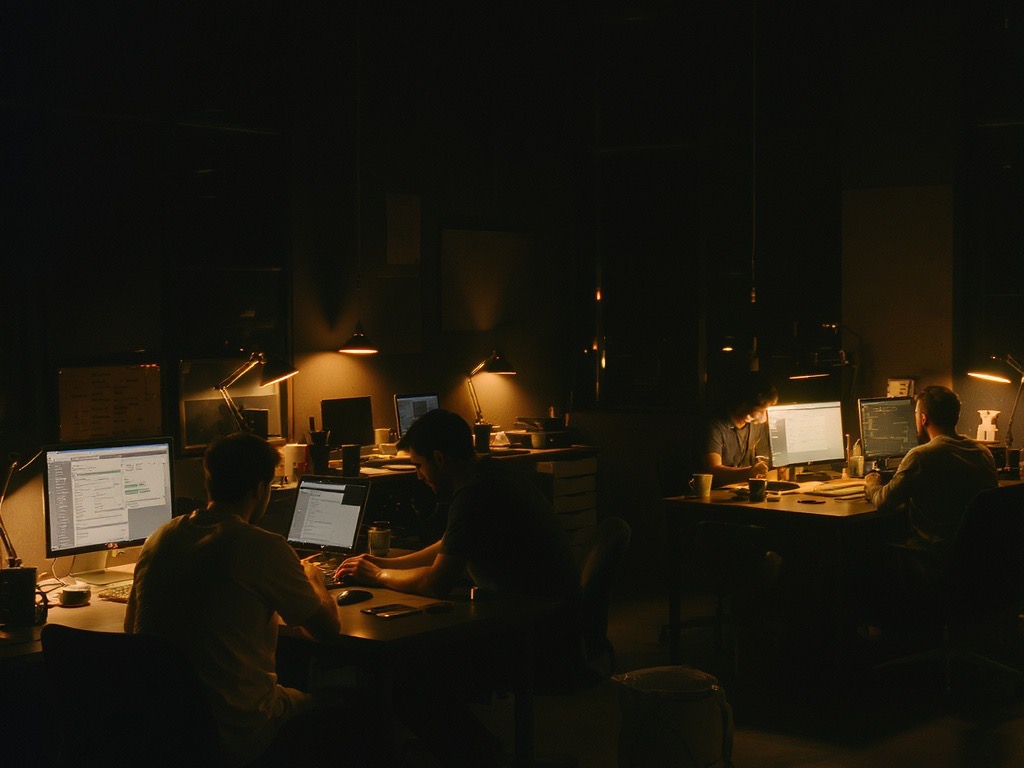
The Syntaxe studio floor at night, engineers at work under individual desk lamps.
syntaxe · the practice that funds the lab
Two engineers inside a large industrial plant room, dwarfed by the machinery they are examining.
the systems that cannot be switched off
why now

Capability is arriving faster than the means to trust it.

Autonomous systems are being handed authority over money, data and infrastructure. Scientific evidence is being produced faster than it can be examined. Legacy estates that cannot be switched off are being modernised on promises rather than proof. Regulation in every one of these areas is moving from principle to obligation.

The market has spent a decade buying capability. It is starting to have to buy assurance as well, and assurance is difficult to retrofit onto a system that was never built to be inspected. Syntaxe builds for inspection first, which is a head start in that shift rather than a guarantee about it.

what compounds

The advantage is not access to a model. Anyone can rent that.

Domain architecture
The structure of a legal matter, a scientific claim, an agent mesh, or a legacy estate, modelled properly. This is years of specialist work per domain and it does not come out of a general-purpose model.
Proof infrastructure
The rigs, oracles and harnesses that let a claim be verified rather than asserted. Expensive to build, invisible from outside, and the reason a Syntaxe claim can be re-checked by someone who does not trust us.
Evidence structures
The machinery that carries provenance, uncertainty and authority through a system instead of discarding them at the first transformation. Reused by every engine we build.
Verification discipline
An institutional habit of proving before claiming. It is cultural, it is slow to acquire, and it is the hardest of these four for a competitor to buy.
the team

Founder led. Built for leverage.

Syntaxe is built around a focused senior core, supported by specialist engineering capacity where each system demands it. This structure has allowed us to work from first principles, protect the integrity of the architecture, and direct expertise toward defined technical obligations rather than headcount for its own sake.

The output has been disproportionate to the size of the company. SOVEREIGN, AWATUM, VERITY and the wider Syntaxe systems have been developed through a disciplined model in which claims are earned, evidence is preserved, and complexity is added only when the work requires it.

Investment expands the depth, velocity and institutional capacity needed for the next stage: additional engineering against named systems, stronger customer deployment capability, formal verification depth, security and assurance, and the commercial operations required to take proven systems into regulated enterprises.

We will grow deliberately, but not timidly. Every addition must increase what Syntaxe can prove, deliver or support.

what capital unlocks

Technical proof, converted into institutional capacity.

Investment converts technical proof into institutional capacity: deeper engineering, customer deployments, formal verification, enterprise assurance and commercial execution. It is acceleration of a system that is already producing, not funding to repair one that is not.

Engineering depth
Specialist capacity added against named systems, so the programmes advance in parallel rather than in sequence.
Customer deployment
The capability to put a proven system inside a customer's estate and support it there, which is a different discipline from building it.
Verification and assurance
Formal verification depth, security and the assurance evidence a regulated enterprise requires before it will accept a system at all.
Commercial scale
The commercial operations required to take systems that already hold up into regulated enterprises at volume.
You receive
Round size, structure and terms. The commercial pipeline and its current state. Milestones the round is priced against, and what happens if they slip.
And
A technical appendix per system: what is built, what is proven, what is claimed but not yet proven, and how to verify each one yourself.
When
Within the same week you ask. No qualification call before you are allowed to see anything.

If you would rather start by pressure-testing a system than by reading about one, say so and we will do that instead.

what would falsify this

The risks we would raise if we were you.

A company whose entire thesis is that limits belong in the output should be willing to state its own. These are the questions we would press hardest on, and we would rather answer them in the first meeting than the fourth.

Breadth
Six domains is a lot for a company this size. The counter-argument is the shared method, and it is a claim we expect to be tested rather than believed.
Sales cycles
The buyers who most need verifiable systems are also the slowest to procure them. The engineering practice exists partly so that this cycle is survivable.
Organisational depth
A compact senior core is efficient and it is also a dependency. Building the institutional depth to carry deployment, assurance and support at scale is explicit work this round funds, not something we expect to happen on its own.
Timing
The move from buying capability to buying assurance is visible but not complete. If it stalls, the systems are early rather than wrong.
Everything on this page can be checked before you decide anything. That is the point of building it this way.

The materials cover round size, structure, milestones and the commercial pipeline. Or start by going through a system with the person who built it.

syntaxe ltd · a systems lab and an engineering practice
Syntaxe Ltd · archive

Not a blog.
An archive.

Notes, observations and field reports from inside the lab: the thinking as it happens, kept as it was written. An evolving body of work, not a feed.

more, as the work accrues
These are working notes, not announcements. They are published when the thinking is worth reading, not on a schedule.

If a note raises a question, or you want to examine a claim made in one, the fastest route is to ask directly.

syntaxe ltd · the archive
subsystem online · syntaxe reasoning core
← back
SYX·VRT · syntaxe reasoning core
VERITY
defend what is true
subsystem online · scientific claim verification
scroll ↓
the compiler for science · a live read
“Compound X reduces tumour growth by 40% (p < 0.01).”
illustrative manuscript · reading every claim
an integrity profile, not a verdict. Verity flags signals for expert review; it does not accuse.
scroll · the methods, and why it matters ↓
the stakes
10,000+

papers retracted a year, and the curve is steepening.

A reviewer gets two to four hours per paper: no time to re-derive every statistic, trace every citation, or inspect figures at the pixel level. Verity does that pass in under a minute and hands back a map of exactly what to examine. The hours they never had, spent where they matter.

the methods

Six layers. Every one a published method.

Statistical
GRIM · SPRITE · p-curve
Recomputes whether reported means, SDs and test statistics are even achievable at the stated N.Brown & Heathers, 2017
Image
copy-move · splice · clone
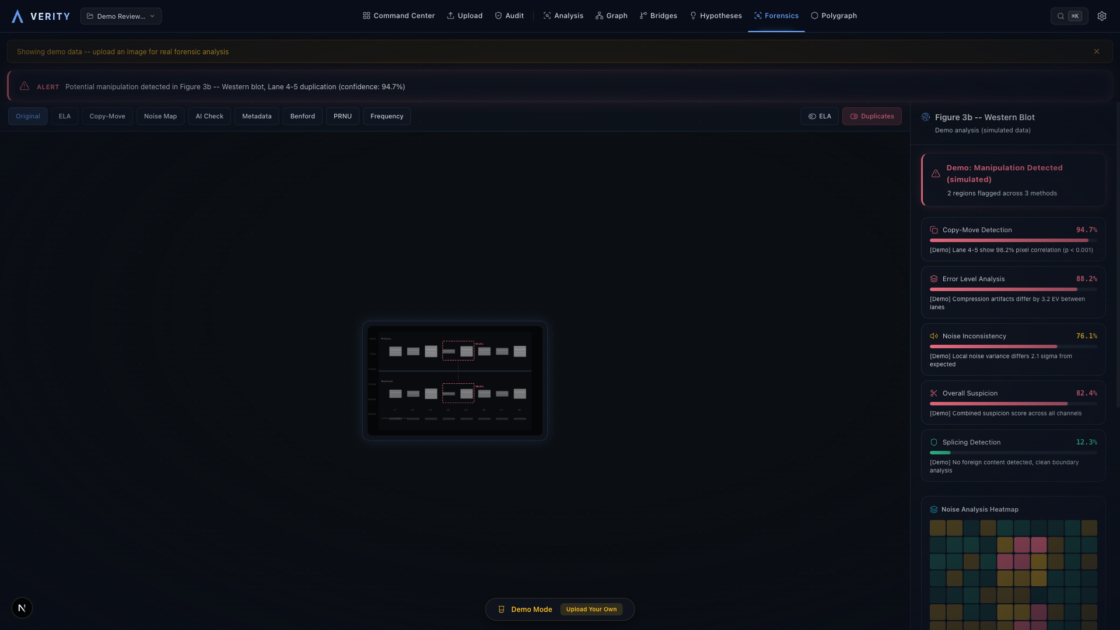
Pixel-level duplication, splicing and gel-band manipulation, via ELA and PRNU analysis.
Reference
citation forensics
Citation rings, retracted-source references and phantom citations, with DOI verification.
Text
paper-mill fingerprints
Tortured phrases and synthetic-text markers characteristic of paper mills.Cabanac & Labbé
Methodology
power & reproducibility
Sample-size adequacy, protocol consistency and reproducibility signals, surfaced, never judged.
Data
internal consistency
Cross-validation of tables, figures and reported numbers against one another.
how we validate

Every finding carries its method, evidence, and confidence.

No black-box "accuracy" score. We report precision and false-positive rate per layer, the numbers that decide whether a tool is safe to point at a colleague's work, validated against the Retraction Watch corpus of documented retractions. Every signal links to the method that raised it. And when the evidence is insufficient, Verity says so: "unverifiable" is a first-class result. (Operating characteristics published as the corpus is processed; we won't quote a number we can't show.)

see it

Caught in the act: shown, with the evidence.

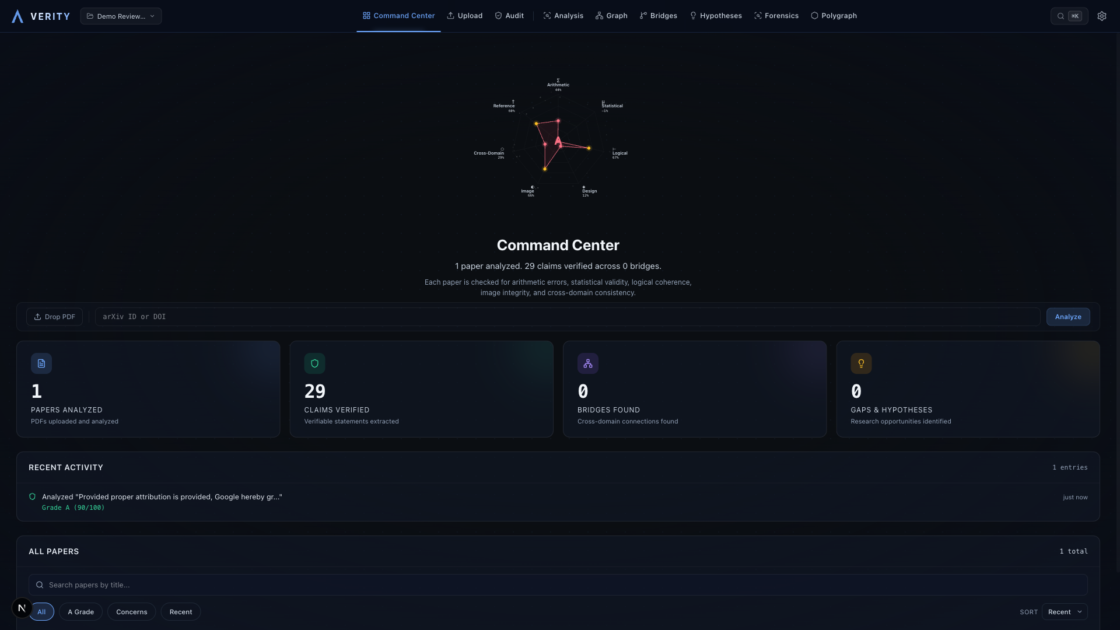
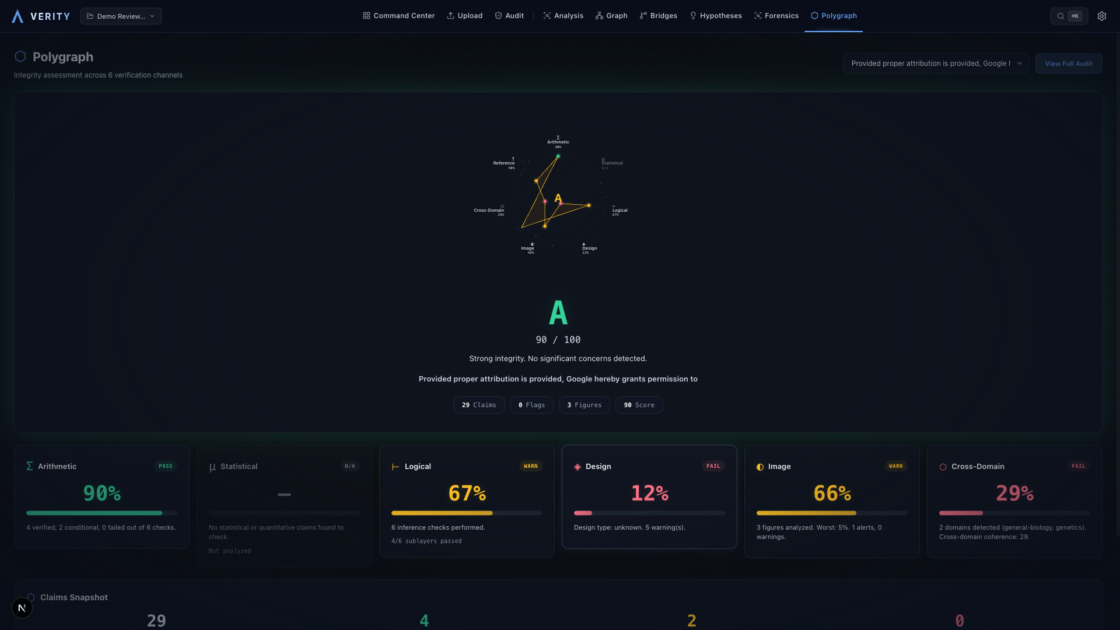
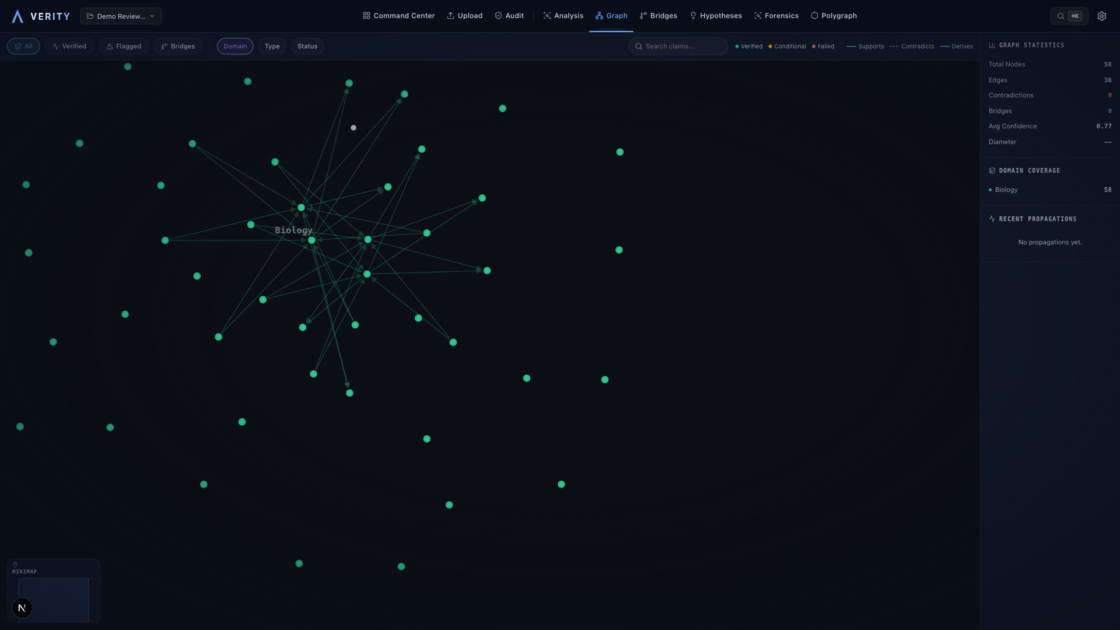
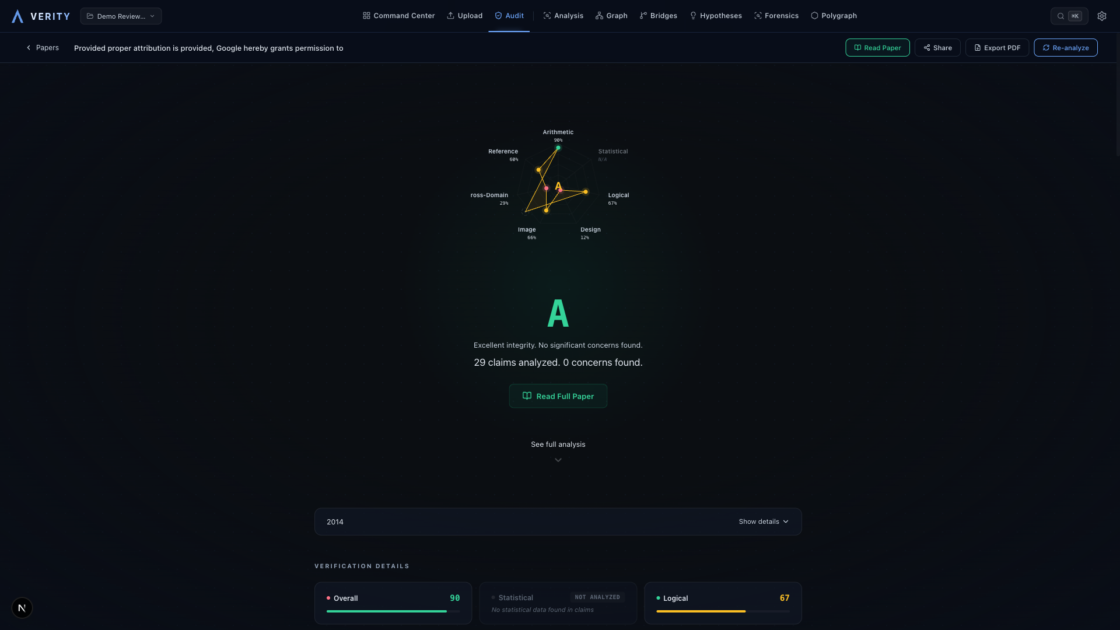
Real screens from the live engine: image forensics catching a manipulated blot, the workspace integrity view, the polygraph’s seven verification axes, the proof graph of linked claims, and a paper graded with every concern shown. Tap any screen to see it full-size.

the line we don't cross

Verity flags. A human decides.

It does not replace peer review, and it never makes a finding of misconduct. Every output is a signal, its evidence shown, handed to an editor or integrity officer to adjudicate. The instrument points; the scientist judges.

who it's for

Journal editors screening before publication. Integrity offices triaging allegations. Funding agencies verifying the work they pay for. Reviewers who want their hours spent where they matter.

Evidence, not verdicts.

A compiler for science: it doesn't accuse you of error. It points to the line and says: look here.

Request access →
verity · a syntaxe reasoning engine
Request access →
SYX·AWT · syntaxe reasoning core
AWATUM
justice, for everyone
subsystem online · computable legal state
scroll ↓
watch it reason

A few plain words in. A reasoned, cited case out.

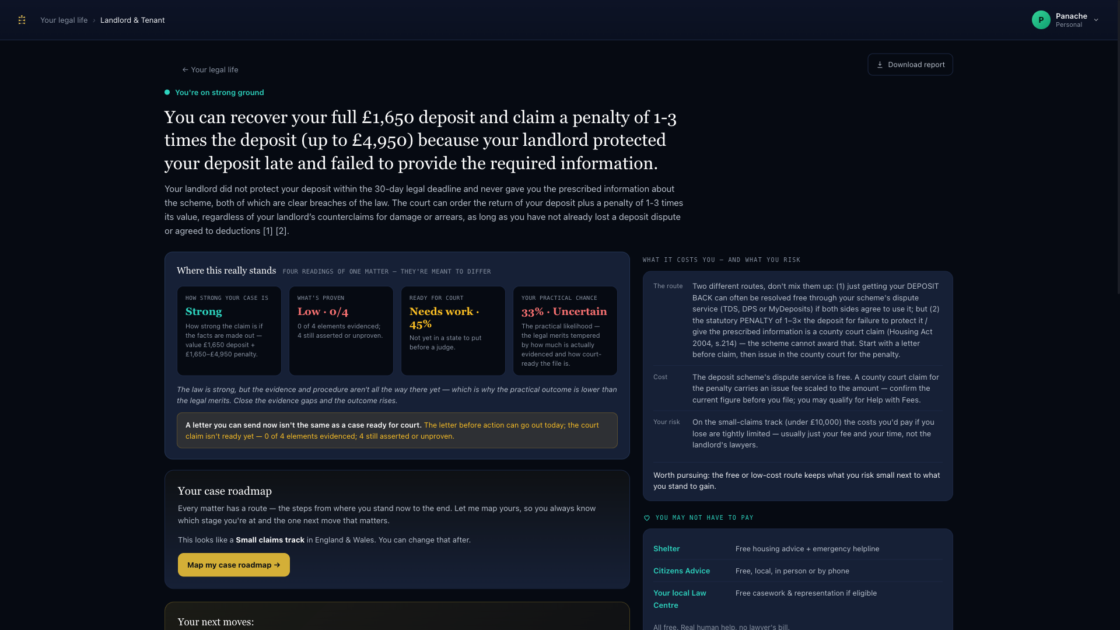
a real situation · decomposed into its legal elements · every claim bound to primary authority
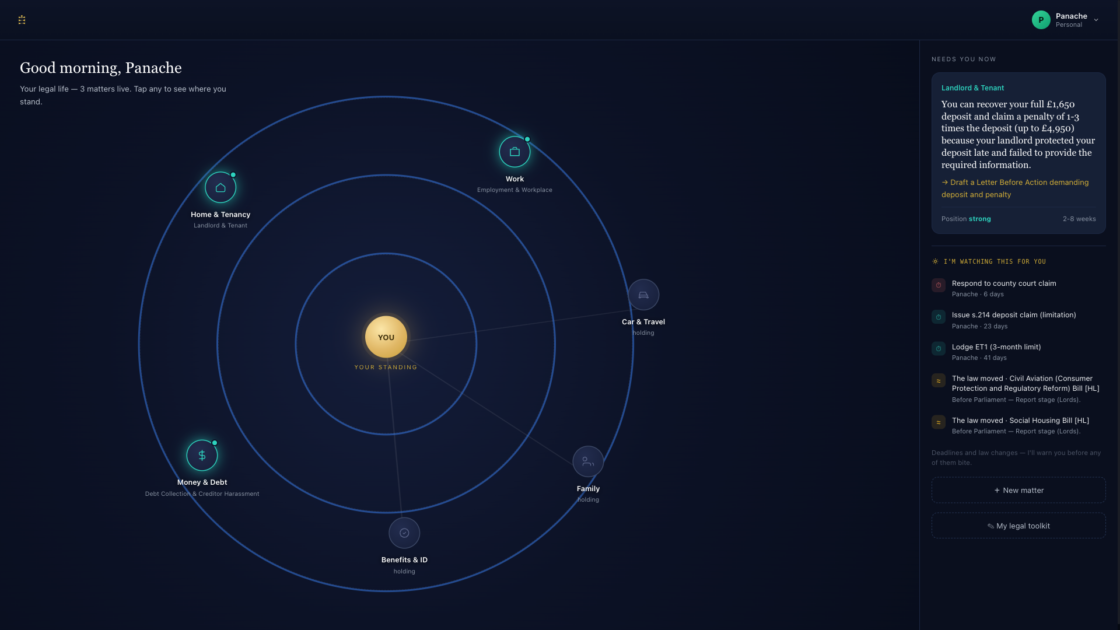
your legal life, alive

Not a question you ask once. A living map of your whole legal life.

YOUyour legal life
Home & Tenancydeposit · active
Workwatching
Familysettled
Money & Debtcourt claim · 6d
Benefits & IDwatching
Car & Travelclear
Every conversation enriches the map; every engine reads from it. Awatum doesn’t answer once and forget you; it holds your whole situation, and watches it over time.
scroll ↓
reasoned over structure, not text

Every answer, traced to the actual law.

Awatum doesn’t keep your case as a wall of text. It builds a graph: the parties, the rights, the duties. It binds every claim to primary authority. Any sentence whose citation isn’t in the verified source is dropped before it reaches you.

You Landlord Tenancydeposit HA 2004 s.214 Hashmi
your rights
Recover the deposit, plus a penalty of 1–3×Housing Act 2004 · s.214
the landlord’s duty
Protect the deposit within 30 daysHousing Act 2004 · s.213
the authority
Late protection still triggers the penaltyHashmi v Gladhart [2011] EWCA Civ 1411
Where others guess, Awatum shows its work, or tells you, plainly, when it doesn’t know.
scroll ↓
one OS · every seat

From your kitchen table to the partner’s desk.

The same engine, the same living graph, projected for whoever sits in front of it. One operating system for the whole of law, not five separate products.

You

Your whole legal life as one map: every right, deadline and matter, in plain words.

The founder

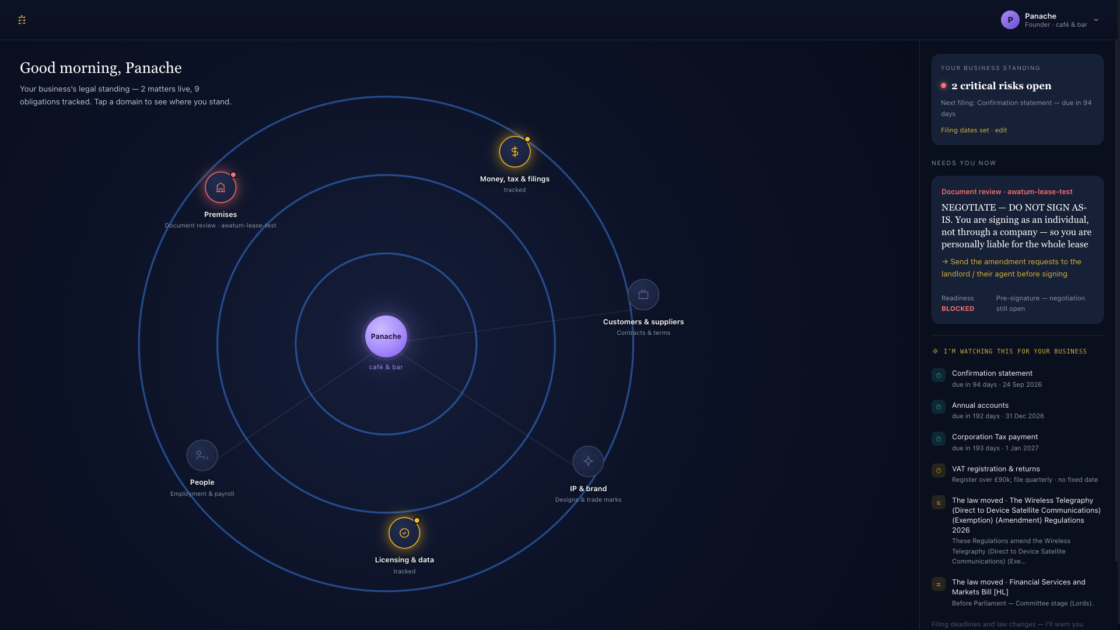
Your company’s exposure, watched continuously: risks flagged before you sign.

The firm

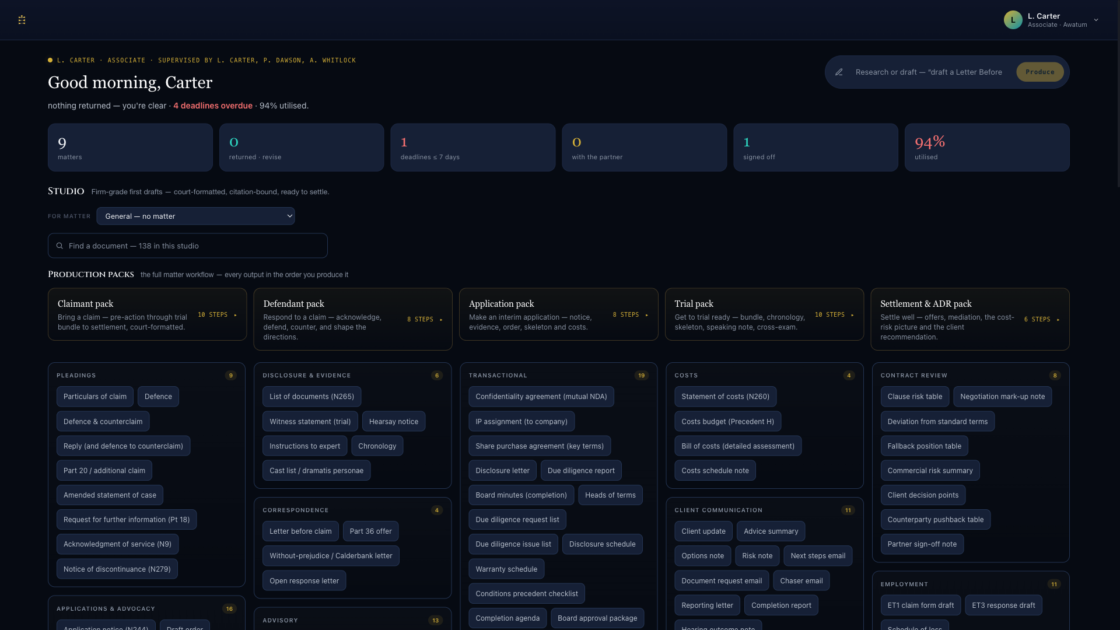
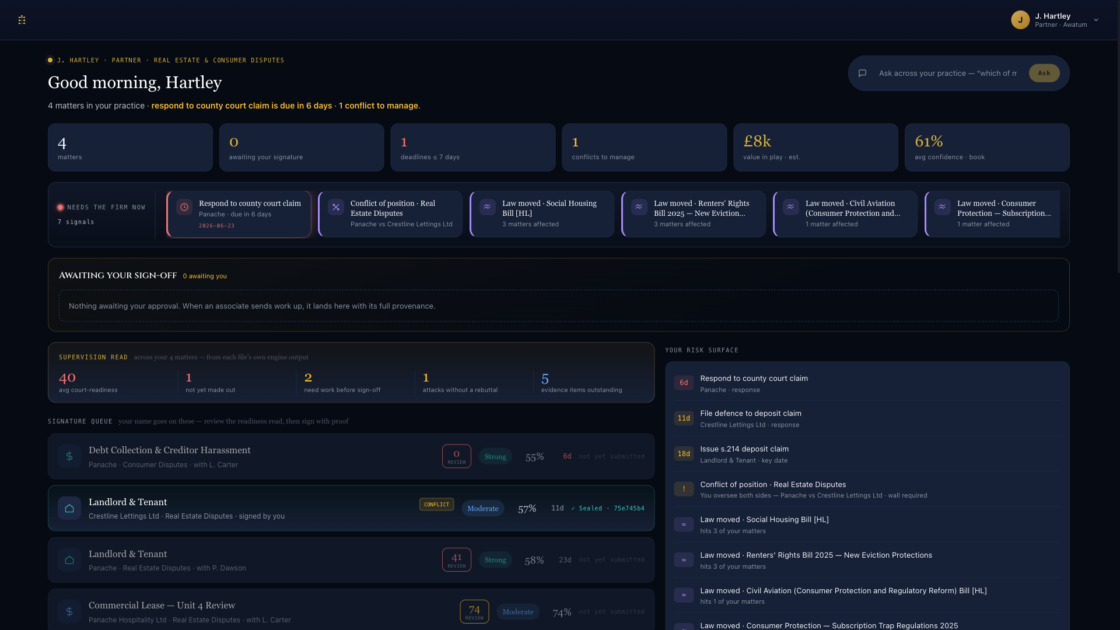
A whole practice: intake, caseload, drift and partner sign-off, every output sealed with proof.

scroll ↓
the crisis
5.1bn

people have no real access to justice.

Eighty-five percent of people with a civil legal problem get no professional help. The system exists, but only for those who can afford it. The law is written for solicitors. Awatum rewrites it for humans.

the difference

Most legal AI searches. Awatum reasons.

a chatbot

Finds documents containing the word "negligence," summarises them, and can confidently cite a case that does not exist.

awatum

Decomposes negligence into its legal elements (duty, breach, causation, damage), scores each against your facts, computes the odds, and models what the other side will argue. Every step inspectable.

justice with certainty

It cannot make up the law.

Every claim Awatum makes carries citations to primary authority: the actual statute, the actual judgment. Any sentence whose citation isn't in the verified source is dropped before it ever reaches you. Where others guess, Awatum shows its work, or tells you, plainly, that it doesn't know.

the legal life graph

Not a chat that forgets. A memory that grows.

Every person has a living map of their legal existence: the people, the contracts, the rights accruing, the deadlines approaching. Every conversation enriches it; every engine reads from it. Awatum doesn't answer a question and forget you; it holds your whole situation, and watches it over time.

the shadow

The other side's best argument, before they make it.

After every new fact, Awatum quietly runs the opposing case against you: the strongest attack, the weakest joint in your position, the three moves a sharp opponent would try. You never walk in unprepared.

drift

The law changes. You know in two seconds.

When a statute is amended, every case it touches re-reasons automatically, and the people affected see their position move in about two seconds. You are never quietly out of date.

twenty-eight engines

One mind. Four kinds of power.

🛡
Shield
Catch the harm before it lands: unread clauses, missed rights, deadlines you didn't know you had.
Sword
When you must fight: strategy, precedent, the document drafted, the opponent modelled.
Map
See the landscape: simulate ten thousand outcomes, read the judge, know the odds before you act.
Bridge
Cross every border: jurisdictions, languages, and the gap between human worry and formal law.
see it

One operating system. Every seat.

Real screens from the live system: a tenant's whole legal life, a case reasoned and cited, the founder's exposure, the advocate's drafting studio, the partner's sign-off, the whole firm. Tap any screen to see it full-size.

with dignity

It simplifies the language, never the respect.

Awatum meets you where you are, your situation, your language, the urgency in your voice, and never questions your intelligence. It says "you have the right to," not "you should have known." End-to-end encrypted. It never trains on your case. Your data is never sold.

the line it won't cross

It informs. It never pretends to be your lawyer.

Awatum makes the law legible and your options clear, and tells you, plainly, when you need a solicitor, then helps you find one. You stay in control of your own case.

the operational record

Running in production. Measured, not promised.

AWATUM has been in production since July 2026. This is the state of the system as measured on 3 August 2026: each line is a gate that fails the build loudly when it stops being true.

$ awatum attest · 2026-08-03 environments … dev · staging · production one schema · drift zero interface ……… every route checked against its schema enforced in CI registers ……… append-only · terminal rows immutable held client files … sealed per firm before touching disk sealed audits ………… four independent cold audits · 2026-07 three remediation tiers live authority …… legal action requires a named human approval human-gated ───────────────────────────────────────────── verdict: OPERATIONAL · in production since 2026-07 · re-measured at every release
who it's for

The tenant whose deposit vanished. The worker fired without notice. The parent in a custody fight. The migrant facing a system in a language not their own. Anyone the law was meant to protect, and didn't, until now.

A complete legal mind. For everyone.

Not when you can afford it. Not when you find the right lawyer. Now, in words you understand.

Request access →
awatum · a syntaxe reasoning engine
Request access →
SYX·KRN · syntaxe reasoning core
KERN
contained, and proven
subsystem online · provable AI containment
scroll ↓
watch it contain a mesh

An AI agent that cannot leak your data. Proven, not hoped.

an agent mesh · compiled to a runtime monitor + a re-checkable proof · a leak attempt, caught at the boundary
why it exists

Every other guard ships an alarm. KERN ships a proof.

The whole agentic-security market, the funded names included, watches your AI agents and raises a probabilistic flag when something looks wrong. KERN takes the agent mesh's declared tools and data labels and proves it cannot route protected data to an undeclared sink, or exceed its authority, for any input or prompt injection, or it hands you the exact path that can.

how it works

Declare. Compile. Prove. Certify.

01 · Declare
Tools & labels
Point KERN at the mesh: its agents, the tools they hold, where sensitive data lives, and who's allowed to delegate to whom. A tiny, total policy, no escape hatch.
02 · Compile
A finite world
The bounded action-space lowers to a finite containment system: every flow an edge, worst-case wiring assumed. That finiteness is what makes "for all inputs" decidable.
03 · Prove
Non-interference
A monotone fixpoint settles the question: can a protected label ever reach a forbidden sink? Contained, or a concrete counter-example path you can read.
04 · Certify
A portable proof
Out comes a runtime monitor that enforces the verdict, and a certificate an outsider can re-check offline, trusting no one but the math.
the certificate

Trust no one. Re-run the math.

KERN's proof carries no signature on purpose. A signature lets a vendor assert safety; KERN lets an insurer, an auditor, or a counterparty agent re-derive it, in an air-gapped room, depending on nothing KERN controls. Trust comes from re-running the proof, not from believing the prover.

$ kern verify ./mesh.cert lattice ……… re-derived from cert tables ok non-interference … no protected→sink path CONTAINED value obligation … amount ≤ position ∀ inputs UNSAT of ¬obligation → holds ────────────────────────────────────────────── verdict: CONTAINED · re-checked offline, trusting no one
the value layer · first room: on-chain agents

Not just "no leak." amount ≤ position.

For agents that move money, "don't leak" isn't enough. KERN's value predicates prove the arithmetic too: that a keeper agent can never withdraw more than a position holds, for every input, the Certora-shaped guarantee, discharged as a proof rather than a fuzzing campaign that merely failed to find a bug.

the line it won't cross

It proves what it can. And says plainly what it can't.

KERN does not bluff. Its guarantee holds over the declared, bounded mesh, not over code it never saw. Multi-step running invariants and live on-chain label capture are named, on the roadmap, and honest about their status. A proof that overclaims is worse than an alarm; KERN would rather show you its edge than hide it.

who it's for

The team shipping autonomous agents into production who need more than a dashboard's good feeling. The insurer underwriting an agent and pricing real, re-checkable risk. The auditor and the counterparty who must trust an agent they didn't build, and now can, because the proof re-runs in their hands.

Containment you can re-check.

Request access →
kern · a syntaxe reasoning engine
Request access →
SYX·ANL · syntaxe reasoning core
ANNEAL
hardened under fire
subsystem online · adversarial security testing
scroll ↓
watch it harden an estate

It attacks you on a loop, so no one else's attack lands.

an estate · continuously red-teamed · the reachable path found, sealed, and re-proven closed
why now · the threshold
181

working exploits one model found in a single browser. The generation before it found two.

That discontinuity is the whole reason ANNEAL exists. Frontier models now find and chain real vulnerabilities at a level that used to take a specialist, and over 99% of what they find is unpatched the day it's found. Finding was never the bottleneck. Closing, faster than an attacker who now moves at machine speed, is the game.

the difference

A scanner ranks by CVSS. ANNEAL ranks by what reaches you.

a scanner

Sorts thousands of findings by a static severity that knows nothing about your estate, most of them unreachable, and leaves the fixing, and the risk, to you.

anneal

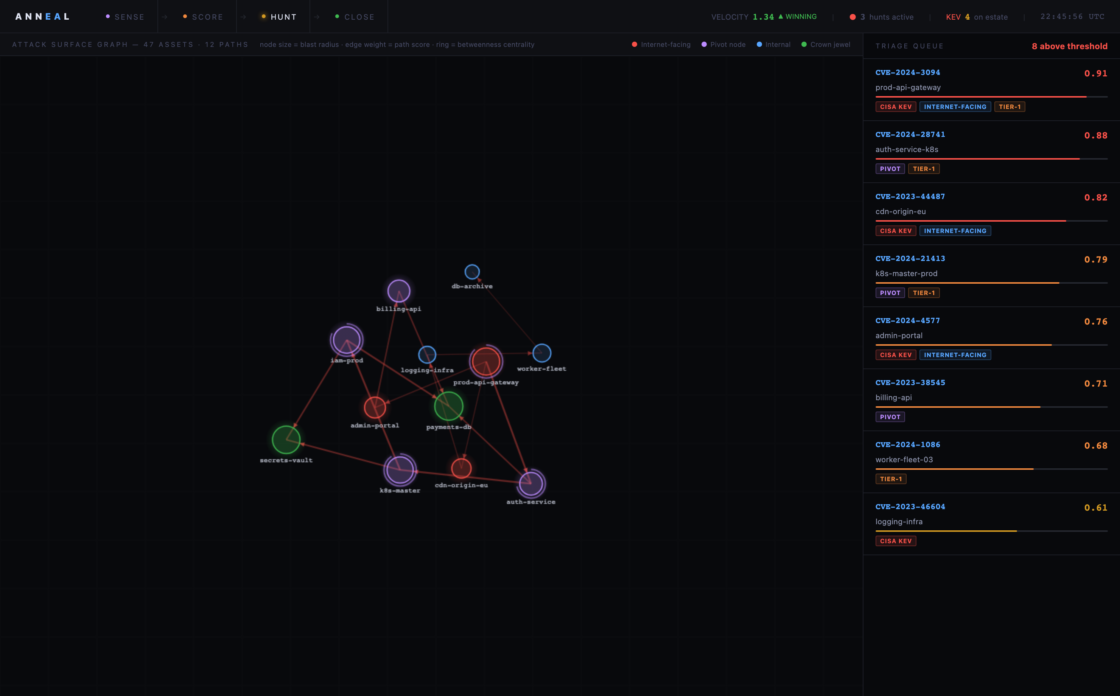
Scores each exposure by an Attacker Priority Score (exploitability, dormancy, blast radius, reach, and chain position), surfaces the few paths that reach a crown jewel, and closes them behind a health-gate.

how it works

One loop. Sense. Score. Hunt. Close.

Sense
behavioral dormancy
Read-only connectors watch what assets actually do. TORPOR flags the behaviours that mean an attacker is present: a dormant box waking, a key never rotated, the quiet ones touched first.
Score
attacker priority, not CVSS
A weighted geometric mean of exploitability, dormancy, blast and surface, lifted by a finding's betweenness in the attack graph. Every component stored, every score re-derivable.
Hunt
autonomous red-team
An LLM red-team works each high-priority asset, and the chains between them, in an isolated, network-less container. A finding counts only if an exploit script reproduces it.
Close
patch · virtual patch · isolate
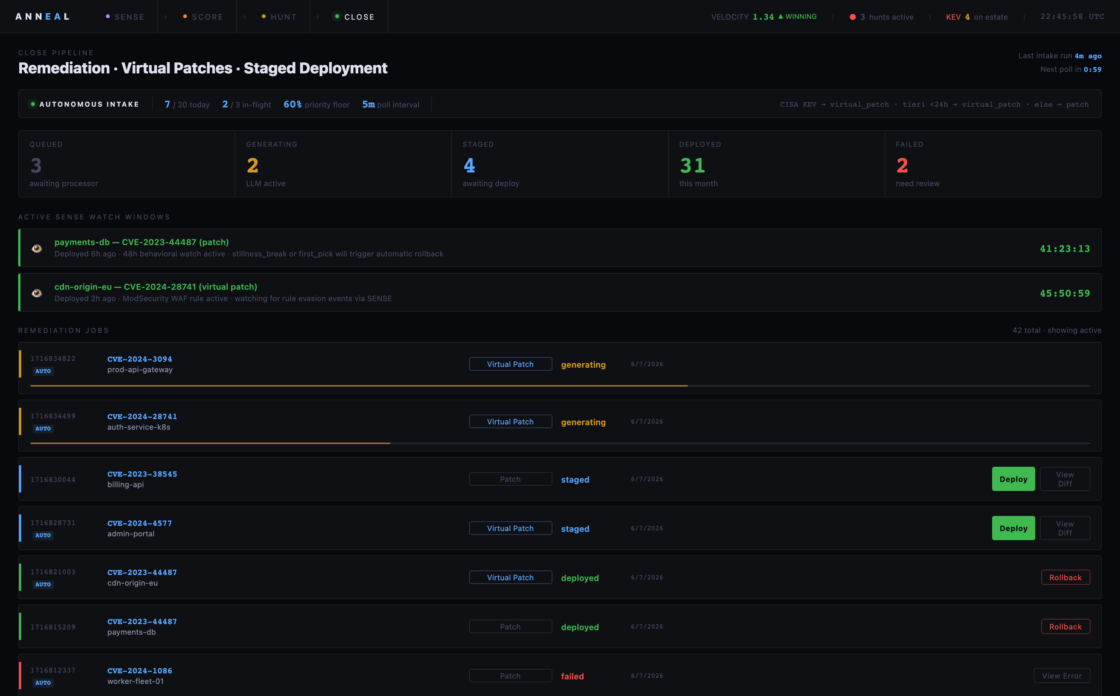
Container-tested, canary → pilot → full, health-gated with auto-rollback and a 48-hour behavioural watch after. ANNEAL never writes to your estate without your approval.
torpor · the tell

Attackers move differently than you do. TORPOR reads the difference.

first_pick
the quiet one, first
A dormant asset touched while ≥70% of its neighbours stay untouched: the signature of picking the forgotten system before the watched ones.
stillness_break
awake after silence
A service untouched for 14+ days suddenly active: reactivation, or reconnaissance on something everyone forgot.
rotation_breach
a key never turned
A credential unrotated past 90 days on a high-blast asset: a stale, silent surface waiting to be used.
wake_on_crisis
three at once
Three or more dormant assets waking inside an hour: the shape of lateral movement through the segments no one monitors.
no black-box score

Every number, re-derivable.

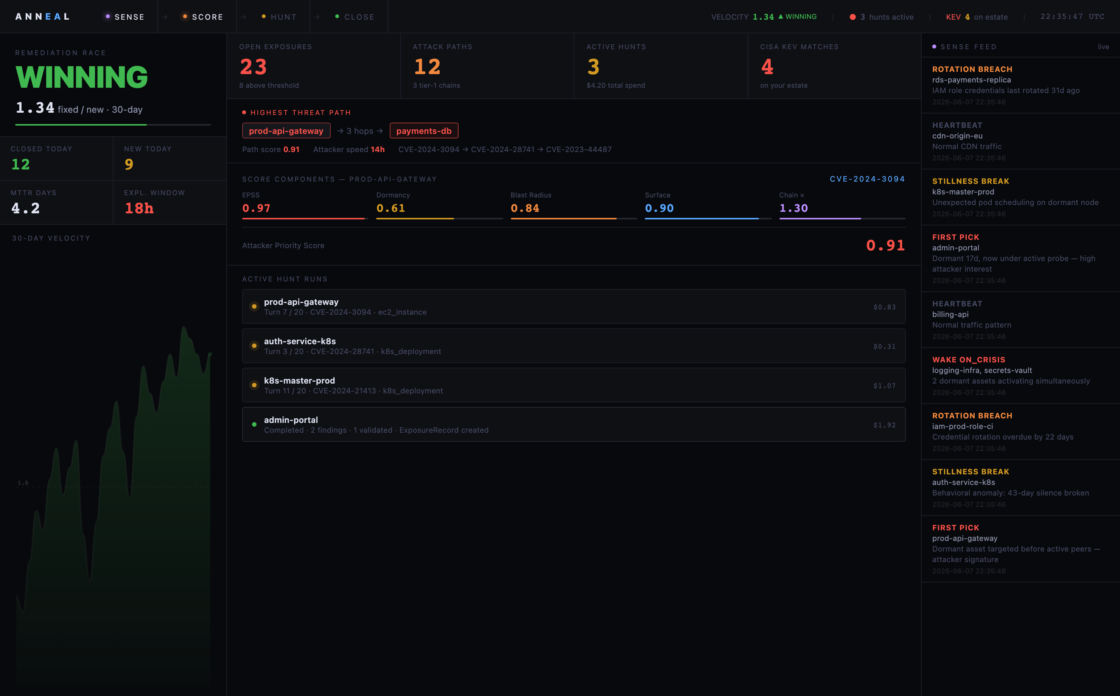
ANNEAL's priority isn't a vendor's opinion. Each exposure stores all five components and the chain multiplier, so an auditor can re-compute the 0.91 by hand, and a closed path carries a record anyone can re-check.

$ anneal score prod-api-gateway → payments-db epss ………… 0.97 CISA KEV → pinned to 1.0 dormancy …… 0.61 first_pick fired · 14:23 UTC blast ……… 0.84 reaches payments-db (0.97) surface …… 0.90 internet-facing entry chain ……… ×1.30 betweenness · 3 shortest paths ────────────────────────────────────────────── APS: 0.91 window 14h every term stored, re-checkable
see it

One screen. The whole race.

Everything above, on one console: the highest-reachable path scored 0.91, the hunts running now, the CLOSE pipeline staging fixes, and the live SENSE feed where TORPOR catches the behaviours that mean an attacker is already inside. Velocity 1.34: closing faster than they arrive.

the line it won't cross

Read-only by design. It never touches your estate without you.

Connectors are read-only; hunts run against snapshots, never your live systems, and no patch reaches production without an operator's approval. It also refuses to drown you: four alerts fire, not forty: a new CISA-KEV match, velocity slipping below 0.8, a validated critical finding, a deploy that landed or failed. A tool that cries wolf is a tool you switch off.

who it's for

The team drowning in findings it can't fix fast enough, that needs the path that matters closed, not a longer list. The CISO who has to answer "are we actually harder than last week" with a number that re-checks. The insurer pricing an estate's real, moving risk.

A fix you can prove held.

Request access →
anneal · a syntaxe reasoning engine
Request access →
SYX·CDC · syntaxe reasoning core
CODEC
the genome, computed
subsystem online · computational genomics
scroll ↓
watch the program settle

The genome isn't a text to read. It's a program that runs.

regulatory dynamics · the same code settling into its stable states: the cell identities it can hold
why it exists

The most-sequenced program on Earth, and we still read it as text.

Twenty thousand genes, twenty-eight million methylation sites, one program, running right now in every one of your 37 trillion cells. We have billions of genomes on disk and almost no account of what the program does. CODEC treats regulatory interaction as a vector field over gene-expression state and computes its structure, on real dynamical-systems mathematics, not metaphor.

what the math says
384

stable identities the same code can hold. Counted, not catalogued.

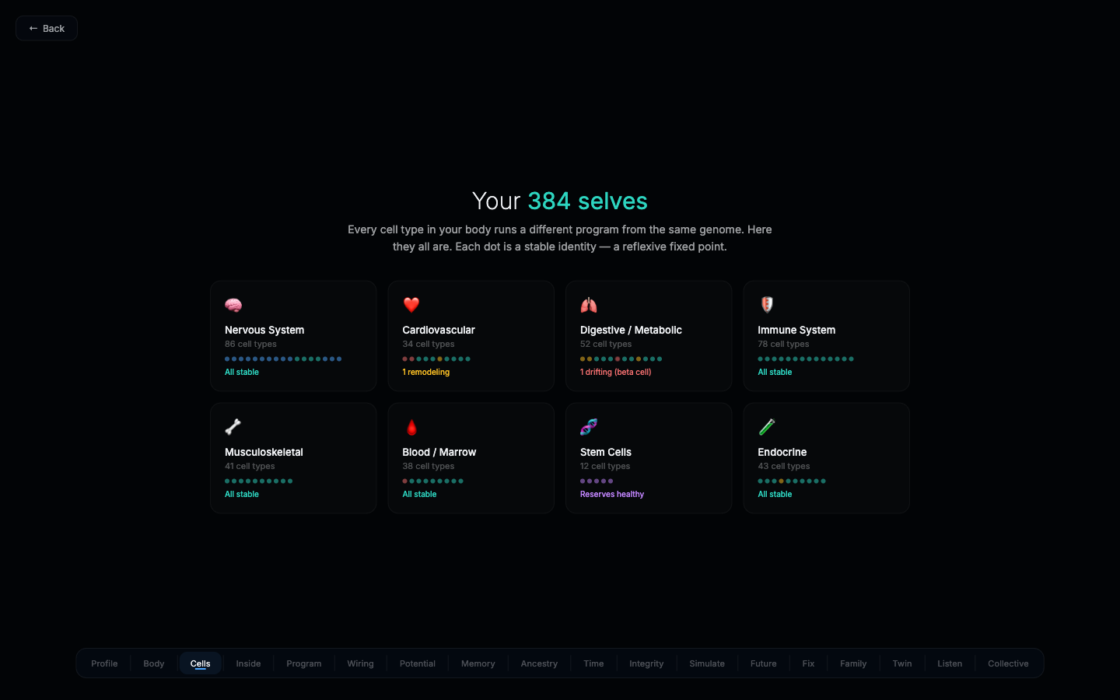
A cell type is a reflexive fixed point: a state where the genome's own dynamics come to rest. Morse-type inequalities bound how many such rests the program admits, #stable ≥ 1 + b₁, and the structure resolves to 384, spread across eight body systems, the nervous system alone holding 86. Not a list someone wrote down; a count the topology forces.

the difference

A browser reads the letters. CODEC runs the program.

a genome browser

Shows you the sequence, three billion letters, the genes, the variants, as a static text to be searched and annotated.

codec

Treats that sequence as a running dynamical system, solves for the stable states it settles into, and maps the routes between them: the genome's behaviour, computed.

how it works

Read. Model. Settle. Map.

Read
a reflexion field
The regulatory network, who activates and represses whom, becomes a map ρ that hands every expression state the vector field the genome would impose on itself there.
Model
dynamics, not metaphor
Each state flows where the network pushes it, across a 47-dimensional manifold. A numerical system you integrate: not a story, a solver.
Settle
reflexive fixed points
Solve ρ(s)(s)=0 by damped Newton, then classify each rest by its Jacobian eigenvalues: stable (a cell type), saddle (a transition), or unstable.
Map
basins & filtration
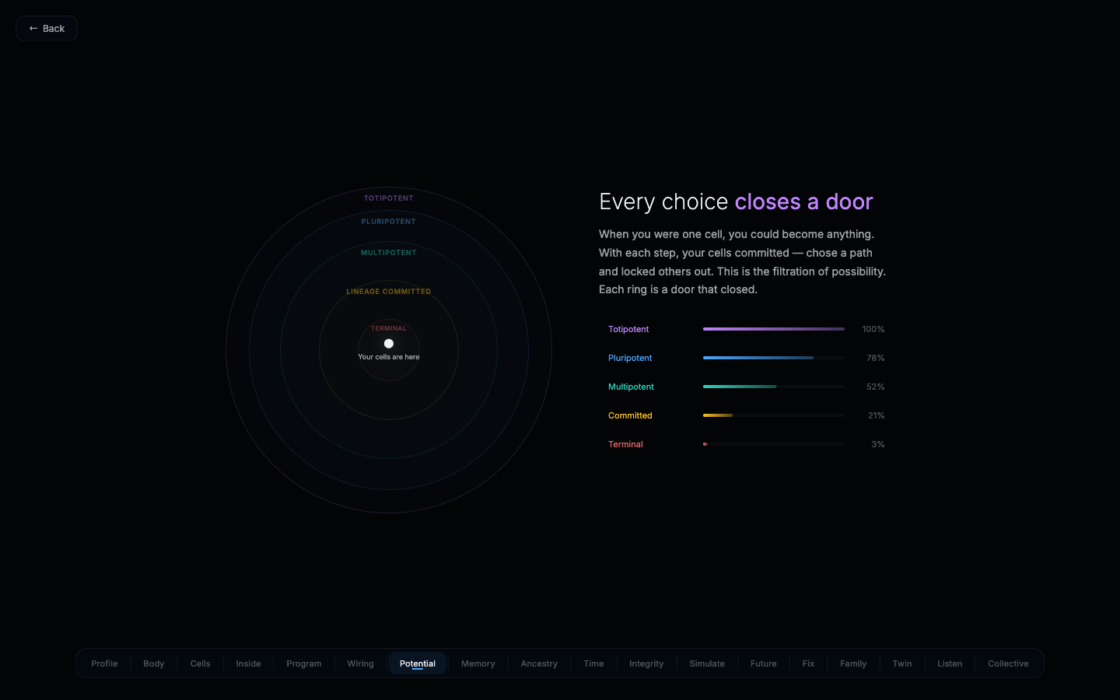
Chart the basin of each identity and the 14-level filtration of possibility: the commitments that, one by one, close the doors a cell can still walk through.
the readout

It computes structure. And shows its work.

CODEC's output is a re-checkable computational readout: the stable states it found, their basins, the routes between them, derived from a model you can inspect, not asserted. Every number traces back to the dynamics that produced it.

$ codec solve ./regulatory.model manifold …… 47-dim · kernel rank 300 built fixed points … reflexive states located 384 stability …… Jacobian eigenvalues classified filtration … 14 levels · basins charted resolved ────────────────────────────────────────────── readout: computational · every value re-derivable from the model
see it

The program, made visible.

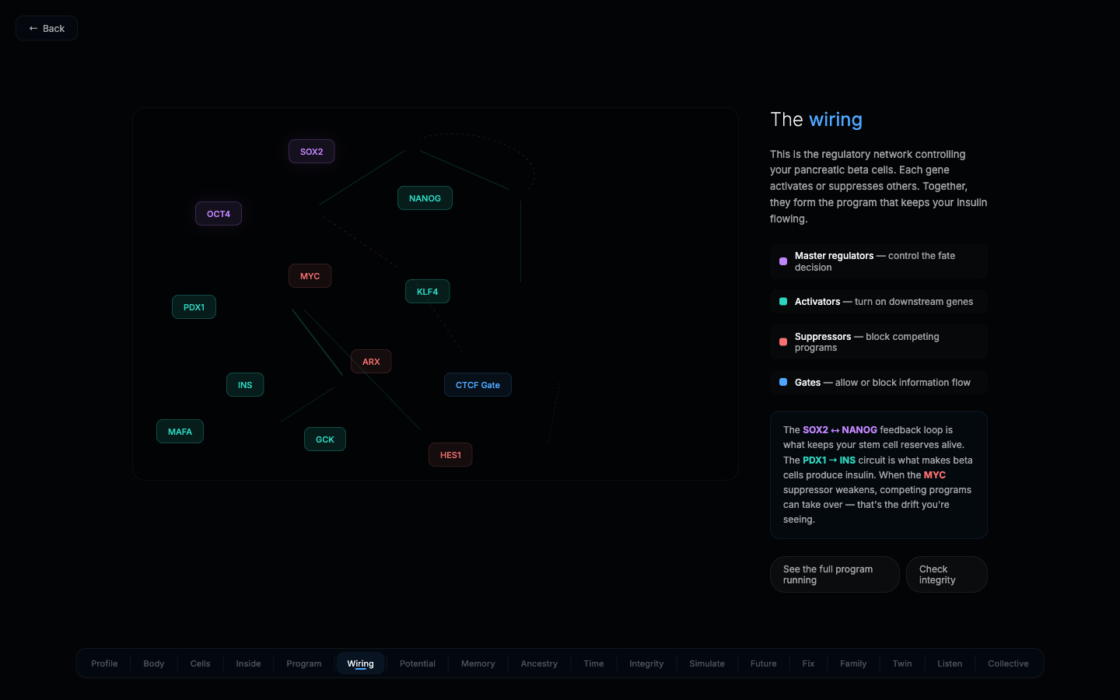
The same dynamics, on screen: your 384 stable identities across eight systems, the regulatory circuits that hold a cell's program in place, and the filtration of possibility: every commitment a door that closes behind you.

the line it won't cross

It is a research instrument. It is not a medical device.

CODEC computes structure in the genome's dynamics, nothing more. It does not diagnose, predict disease, or advise treatment, and it makes no clinical claim about any individual. It is a lens for researchers studying how regulatory programs behave. Where the model's assumptions end, CODEC says so, and stops.

who it's for

The computational biologist who wants the genome's dynamics as a solvable system, not a spreadsheet of reads. The systems-biology lab studying cell-state stability and reprogramming. The researcher who needs every number to trace back to a model they can interrogate.

The genome, as a system you can solve.

Request access →
codec · a syntaxe reasoning engine
Request access →
SYX·SVR · syntaxe verification system
SOVEREIGN
the original is the oracle
subsystem online · verified legacy modernisation
scroll ↓
watch the verdict compute

The replacement is not trusted. It is proven.

your system and its rebuild, executed live · same inputs, same outputs · a decision you can defend
why sovereign exists

A defensible go or no-go, before production.

Somewhere in your estate is a system no living person fully understands, quietly deciding what the business does every day. Every rewrite so far has been hoped to behave like the original, never shown to. Sovereign exists so the day the replacement carries the business is never a leap of faith: you see the proof before you commit, and the evidence is yours to keep.

translation is not proof

Others generate the replacement. Sovereign proves it against the original.

the market

Translation tools, refactoring platforms, AI rewrites. They all hand you new code and ask you to trust it. The risk stays exactly where it started: with you.

sovereign

Hands you the verdict instead: computed proof that the new system behaves like the one that runs your business, evidence your own engineers re-run, and every open risk named to your face before you decide.

where it leads

Prove one cohort. Then map the path through the estate.

01 · prove
Start without fear
A paid, bounded pilot on one cohort. Weeks, not years. The outcome is a decision, not another report.
02 · liberate
Move with confidence
Cohort after cohort leaves the legacy estate, each one proven before it carries live traffic.
03 · own
Take back control
No more hostage negotiations with a forty-year-old system. A modern estate your teams can read, change and hire for. The code becomes yours.
04 · evolve
Never fossilise again
The reconstructed system stays alive: understood, documented and provable every time it changes.
why it is safe to say yes

Designed for your risk committee.

boundary
Your code and data stay yours
Read-only, on-premise or air-gapped: your code and data need not leave your boundary. When we leave, the legacy system is unchanged: nothing was modified.
exposure
Capped from day one
Fixed scope, fixed fee, one cohort. No whole-estate commitment, no open-ended programme.
evidence
Yours to keep
Re-runnable proof your engineers execute themselves, long after we have left the room.
honesty
No undisclosed proof gaps at cutover
Anything outside the earned proof boundary is returned as an explicit red before you decide, not discovered after production traffic moves.
the deliverable

Every line of truth. Found. Verified. Yours.

A verdict you can take to the board: not a consultant’s opinion, not a similarity score. A computed result, re-runnable in your own environment, with every boundary written down. Validated in controlled environments against live vendor compilers and runtimes; detailed evidence is available under mutual NDA.

SOVEREIGN · EQUIVALENCE EVIDENCE (illustrative) cohort one agreed module set oracle your own running system executions live, inside your boundary verdict equivalent within the agreed observation boundary reds named · in the boundary register re-run yours, at any time
who it's for

Built for the people accountable for systems that cannot stop: core banking and payments, insurance and life platforms, settlement engines, government processing estates, hospital and laboratory systems, engineering and scientific code. Systems that have run the business for decades and carry every edge case, every midnight batch, every exception no document remembers. Where the original can still be executed, there is an oracle to prove against. If the system that runs your business is older than the people maintaining it, Sovereign was built for you.

Your system is understood. You have control.

Stop trusting. Start proving. A 25-minute conversation is enough to tell whether one of your cohorts qualifies. The proof architecture and technical dossier follow under mutual NDA.

Request a pilot →
sovereign · a syntaxe system · to be simple is to be sovereign
Book a technical-fit call →