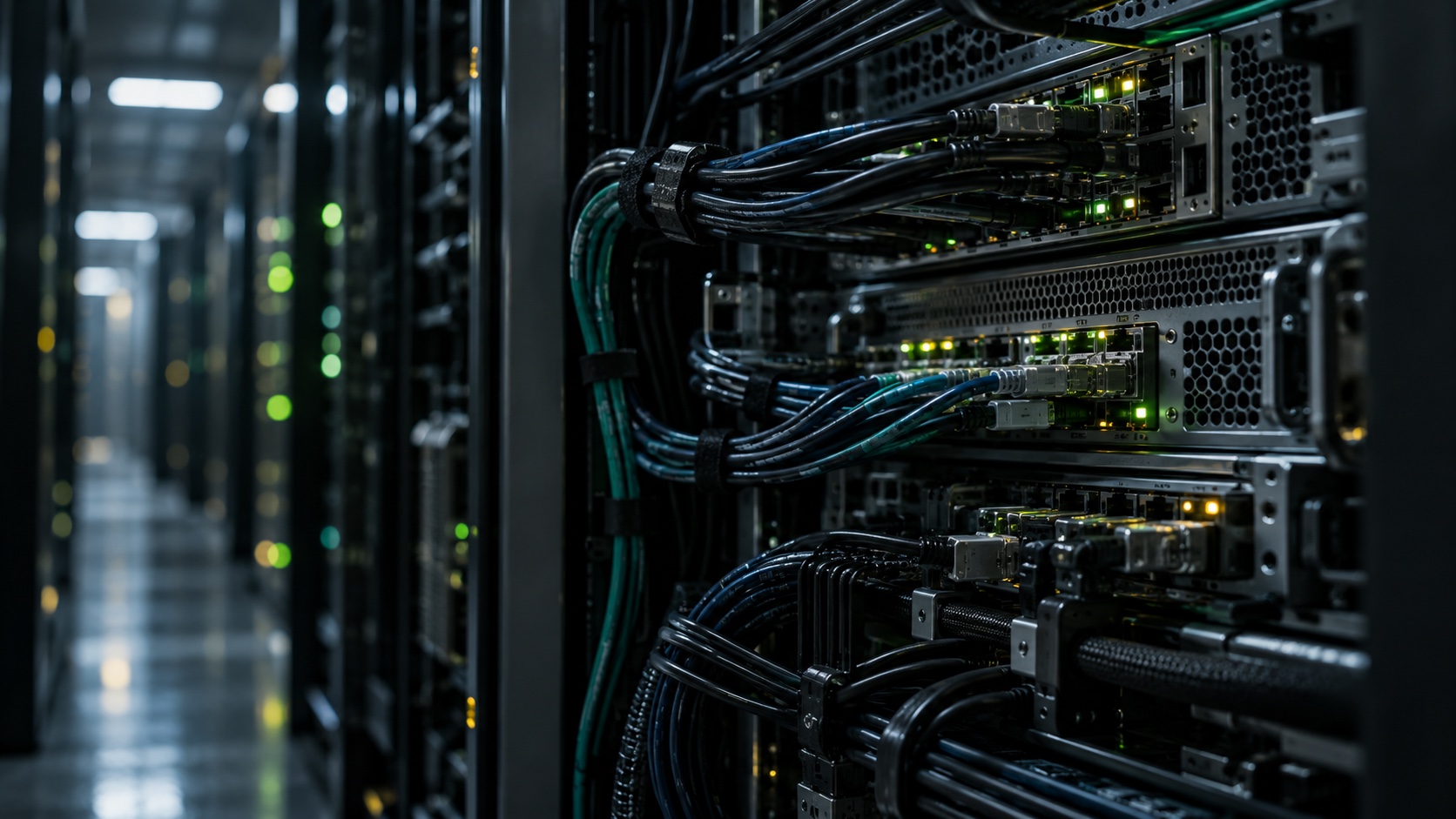
Double-entry bookkeeping has run the world’s accounting for about seven hundred years. Almost nobody who benefits from it has ever seen it at work. Every time a web page loads, the computers involved first exchange three short messages to open a connection, a step called the TCP handshake. No company has ever launched a product about it.
Every bank runs on a ledger, and for years at a time nobody thinks about it. Then, in the one week something goes badly wrong, it is the only thing anyone in the building looks at. The same pattern appears everywhere: the systems that do the most important work are rarely the ones on the screen. They sit underneath it.
Organisations spend more on what they can see
Visible software gets funded, demonstrated and reviewed, because people can point at it. The infrastructure underneath is built once, works quietly for years, and gets noticed only when it breaks. At that point, the cost of not building it properly the first time arrives all at once.
This creates a predictable bias. Organisations spend too much on the screens people click and too little on the systems those screens depend on. The underlying systems never look good in a demonstration and never appear in a screenshot.
Syntaxe has made the same choice in six products
Every product we have built works in this hidden layer. Looking at all six together shows the pattern more clearly than looking at any one of them alone.
Sovereign works on the oldest hidden layer: the decades-old programs that still run banks, insurers and governments. It reads the old code, writes down the rules it follows, and proves that a modern replacement gives the same results. The customers of those organisations never see Sovereign at work. They only see that nothing changed when the system underneath did.
Kern never appears in an AI agent’s own interface: it works underneath a group of connected agents. It takes the tools the agents are allowed to use and the rules about where data may go, turns them into a precise model with a limited number of states, and proves, for every possible input, what the agents can and cannot reach. The agent’s user never sees Kern at work. They only see that the agent could not do something it was never allowed to do.
Awatum keeps a structured record of a person’s legal position: facts, rights, obligations, deadlines and who has authority to act. This record changes over time. When a person asks Awatum a question in plain language, they see an answer. They never see the record that does the real work by linking that answer to the law itself: legislation and court decisions.
Verity does not read a research paper the way a person does. It checks the paper’s statistics, its images, the papers it cites and its methods, and compares each one with the original evidence, reporting back only when these checks are complete. The reviewer sees a figure flagged as a problem. They do not see the seven separate checks that ran to find it.
Anneal runs all the time against an organisation’s computer systems, including when nobody is watching them. In the background, it works out which routes an attacker could actually use to reach and move through those systems. It does this in the long gaps between the moments when a person looks at a security dashboard. Its value is produced when nobody is looking, which is exactly when visible software has nothing to offer.
Codec is our earliest-stage product. It is being built to test if a cell’s history predicts what the cell will become. A snapshot of a cell today cannot show that history, which is why Codec belongs in this hidden layer too.
We chose this layer on purpose
Most of the real risk and most of the real value sit in the hidden layer, because it is the layer nobody checks while it runs. When a visible screen fails, it is an inconvenience. When a hidden system fails without anyone noticing for months, the result can be accounting fraud, a security breach or a retracted scientific paper. These failures happen not because the screen showed something false, but because nothing was checking the layer underneath it.
What building this layer involves
Work on the hidden layer is often unglamorous. It rarely produces something you can take a screenshot of. What it produces lasts longer than the screens built on top of it, which may be redesigned three times in the same period.
Examples from our own products are a proof of an agent system’s limits that holds whichever agent software calls it, a legal record that stays correct when the law it depends on changes, and checks that run the same way on every research paper, whoever submitted it. The visible software will change. If the layer underneath is built properly the first time, everything else can rely on it.
What to ask when you assess a company like ours
If you are deciding whether to fund, buy from or join a company building infrastructure for AI systems, “what does the demonstration do?” is rarely the useful question. The useful question is “what is the hidden layer underneath the demonstration, and has anyone proven that it works?”
That is the layer we have chosen to build in six separate products, on purpose. It decides whether the visible product on top can still be trusted six months after it was first presented.
0 comments